A Vietnam market-entry checklist should not start with “open company.”
That is too late in the thinking. The right checklist starts with whether the plan deserves to become a company at all.
Use this as a practical screen before signing, wiring, hiring, leasing, or committing to a local partner.
Gate 1: activity
Write the business model in operational language.
- What will customers pay for?
- Will you sell goods, provide services, manufacture, distribute, import, export, operate premises, hire local staff, advertise, store goods, process food, handle data, or provide regulated advice?
- Which activity creates the most licensing or market-access risk?
- Are there multiple activities that need to be separated?
If the activity is vague, every later answer becomes soft.
Gate 2: customer and revenue
Vietnam entry should be linked to a real customer path.
- Who is the first paying customer?
- Is demand export-led, local-consumption-led, partner-led, or supply-chain-led?
- What proof exists beyond introductions and enthusiasm?
- What payment method, currency, contract form, tax invoice, and delivery route will be used?
- What would make the first sale legally or operationally impossible?
Many plans look good as strategy and weak as transaction flow.
Gate 3: market access and entry route
Confirm the route before drafting documents.
- Is the activity open, conditional, restricted, or prohibited for foreign investors?
- Is a treaty route relevant?
- Is the better form a new company, acquisition, asset purchase, business cooperation contract, representative office, or staged partnership?
- Will foreign ownership percentage create any condition?
- Does a sector license sit after company setup?
This is where legal confirmation belongs.
Gate 4: location and property
The site must fit the activity.
- Does the address support the registered business line?
- For manufacturing or warehousing, is the site in the right industrial zone or approved premises?
- Are fire, environmental, construction, food safety, logistics, or customs issues relevant?
- Is the landlord authorized to lease for the intended use?
- Does the lease term fit the project timeline and approvals?
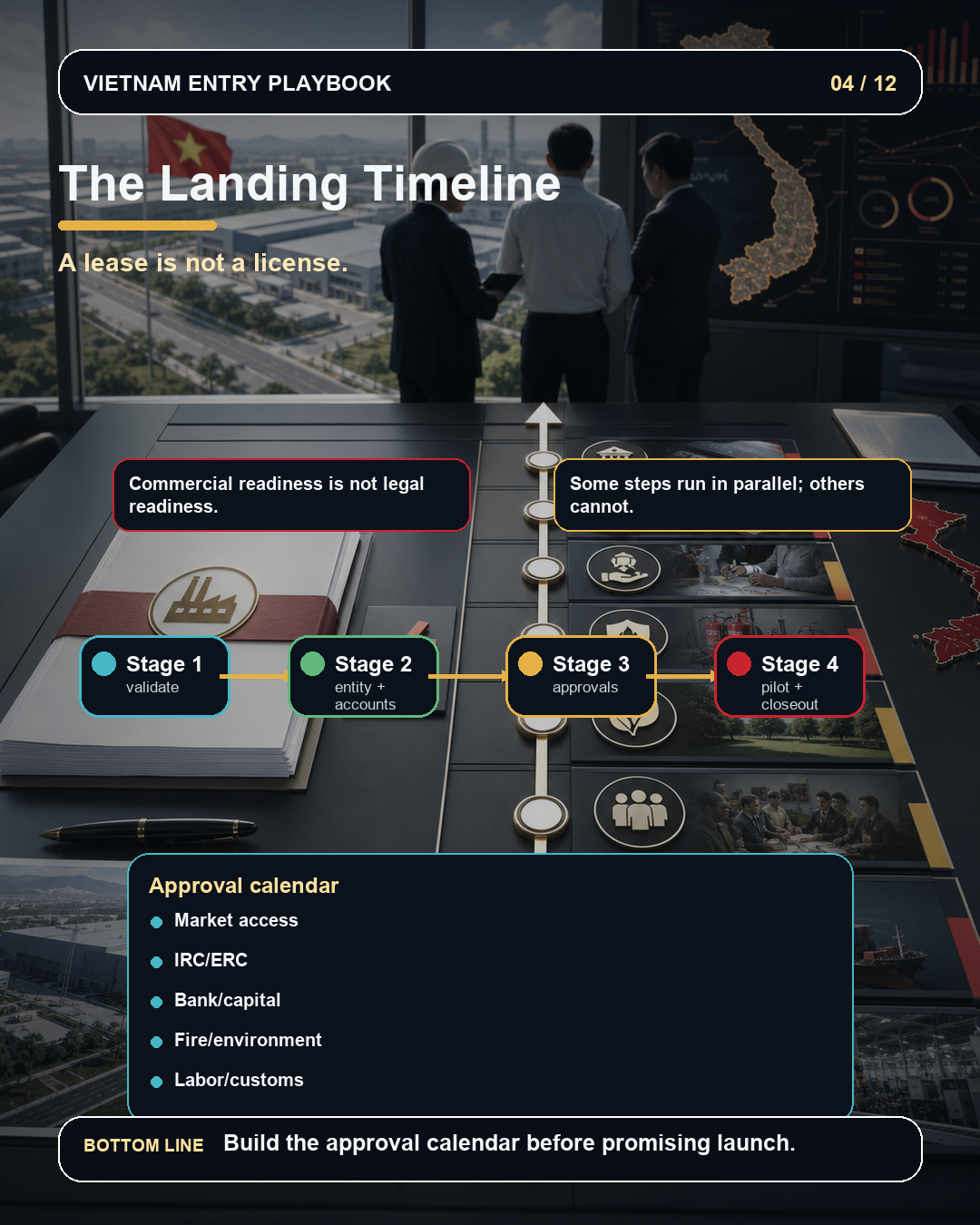
A lease is not a license. Treat it as one input, not proof of permission.
Gate 5: capital and banking
Money should move through a clean path.
- What is charter capital, project capital, shareholder loan, third-party debt, or operating revenue?
- Which account receives each flow?
- What timing or contribution schedule applies?
- Is foreign loan registration relevant?
- What documents will the bank, accountant, and tax adviser need?
- How will profits, dividends, or liquidation proceeds eventually be remitted after obligations are met?
Do not leave banking until after urgency appears.
Gate 6: advisers and accountability
List the specialist map.
- Who confirms legal route?
- Who confirms tax and accounting?
- Who confirms banking and capital movement?
- Who reviews lease and property documents?
- Who checks fire, environmental, labor, customs, or sector permits?
- Who coordinates the tracker so nothing disappears between advisers?
One adviser rarely owns the whole operating reality.
Gate 7: first-100-days control
Before launch, define the control rhythm.
- Weekly decision tracker.
- Approval checklist.
- Cash movement log.
- Partner and supplier notes.
- Risk register.
- Document folder structure.
- Owner dashboard.
The goal is not a beautiful folder. The goal is fewer surprises.
Final screen
Before you move, ask:
- What must be true for this plan to work?
- Who has confirmed it?
- What remains unconfirmed?
- What decision is expensive if wrong?
- What should not happen until the answer is clearer?
If you want to walk through this checklist, send Les “Vietnam Entry Checklist” through WhatsApp, WeChat, or Zalo.