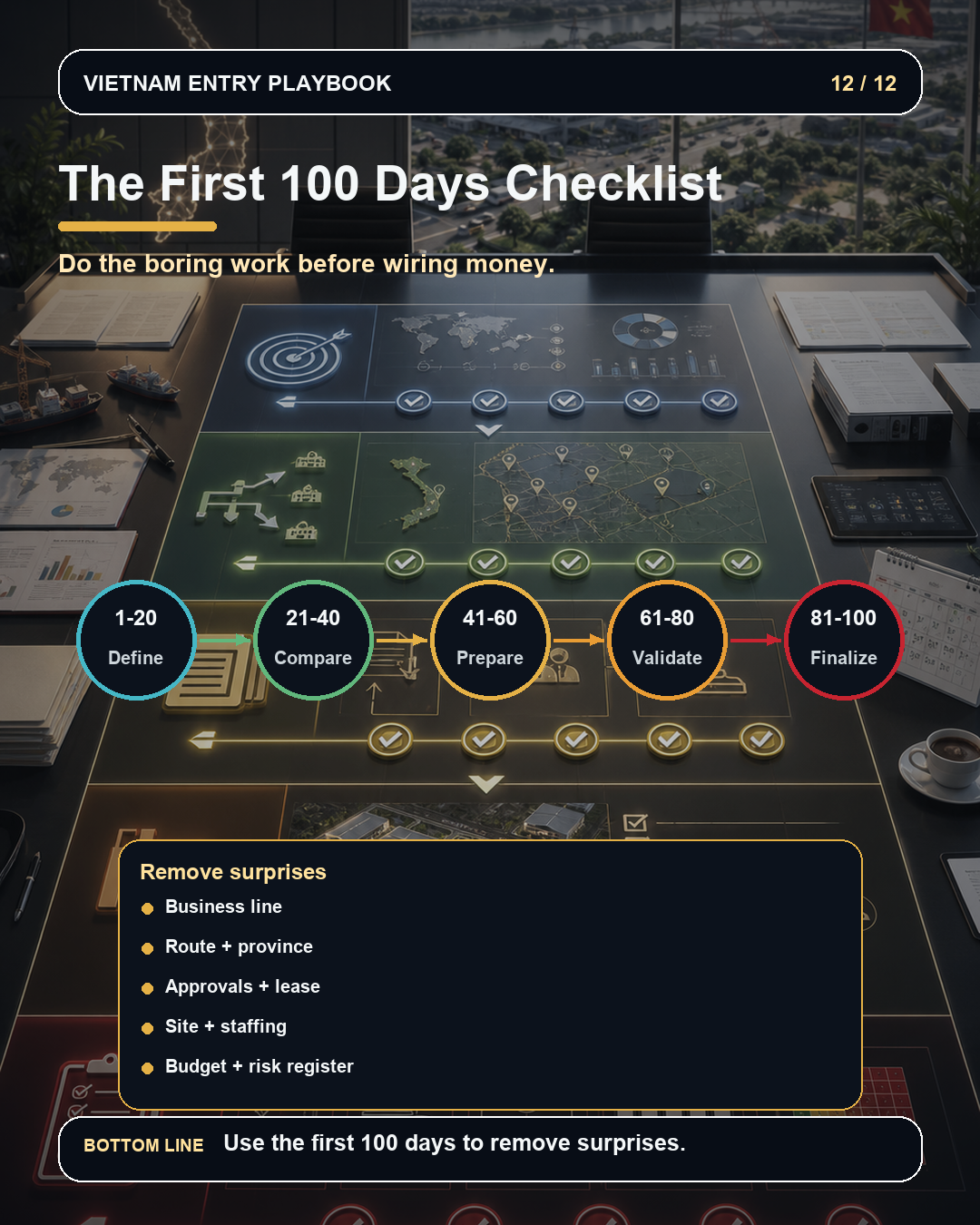
The first 100 days of Vietnam company setup should not be measured only by whether the company exists.
A company can be registered and still be operationally weak. The lease may not fit the activity. The bank route may be late. The owner may still be the only person who knows what is happening. Advisers may be working in parallel without one decision map.
The better goal is simple: by day 100, the business should have a confirmed route, a clear approval map, a capital path, a working control rhythm, and fewer decisions trapped inside the owner’s head.
Days 1 to 15: define the project before the paperwork
Start with a one-page project definition.
Write down the activity, customer type, revenue model, target city or province, site requirement, investor structure, intended capital, operating timeline, and what would make the project stop.
Then split the project into gates:
- Market access and business line.
- Entry route and ownership.
- Location and property.
- Investment registration and enterprise registration.
- Sector permits and operating approvals.
- Banking, capital contribution, tax, and accounting.
- Hiring, suppliers, reporting, and owner control.
This prevents one adviser from solving a narrow form problem while the whole project stays exposed.
Days 16 to 30: confirm the route
Before documents move, confirm whether the project is likely a new company, share purchase, asset deal, business cooperation contract, or representative-office path.
For a new foreign-invested project, check whether an Investment Registration Certificate is needed and which authority is likely involved. For a purchase, check whether foreign ownership, restricted sectors, or sensitive land conditions trigger registration before ownership changes.
Do not rely on one-word answers like “possible” or “easy.” Ask: possible under what activity, with what ownership, through what approval, on what timeline, and with what remaining licenses?
Days 31 to 45: pressure-test the site
The site is not just a commercial decision. It can affect licensing, fire approval, environmental obligations, logistics, staff access, incentives, and operating costs.
For offices, check whether the address supports the registered activity. For factories or warehouses, check industrial-zone fit, lease term, utilities, fire route, environmental route, expansion room, landlord authority, and whether any construction or fit-out approvals are needed.
A cheap lease can be expensive if it creates an approval problem.
Days 46 to 60: map money before moving money
Capital should have a route before it has urgency.
For foreign-invested companies, the banking structure, capital account, operating account, contribution schedule, loan route, supporting documents, tax position, and future remittance path should be mapped early.
The owner should know:
- What money is capital and what money is debt.
- Which account receives it.
- What documents support it.
- What deadline or registered schedule applies.
- How expenses will be approved and recorded.
- What bank or adviser will confirm the flow.
This is where casual shortcuts create later cleanup work.
Days 61 to 80: build the operating rhythm
Once the setup path is moving, build the management rhythm.
The minimum operating system should include:
- Weekly project tracker.
- Approval and document checklist.
- Adviser responsibility map.
- Cash movement log.
- Contract and lease folder.
- Supplier and partner notes.
- Risk register.
- Decision log.
This is not bureaucracy. It is owner protection.
Days 81 to 100: test whether the owner can step back
By day 100, the owner should be able to answer five questions without searching through chats:
- What approvals are complete, pending, blocked, or not yet started?
- What money has moved, and what documents support it?
- Who owns each next action?
- Which risks need specialist confirmation?
- What operating report shows whether the project is on track?
If those answers live only in the founder’s memory, the business is not yet owner-independent.
A useful first-100-days rule
Do not chase speed at the expense of sequence.
Speed helps only after the route is correct. The first 100 days should make the project clearer, not just busier.
If you want a second set of eyes on the first 100 days, send Les the activity, location, current stage, and decision deadline through WhatsApp, WeChat, or Zalo.