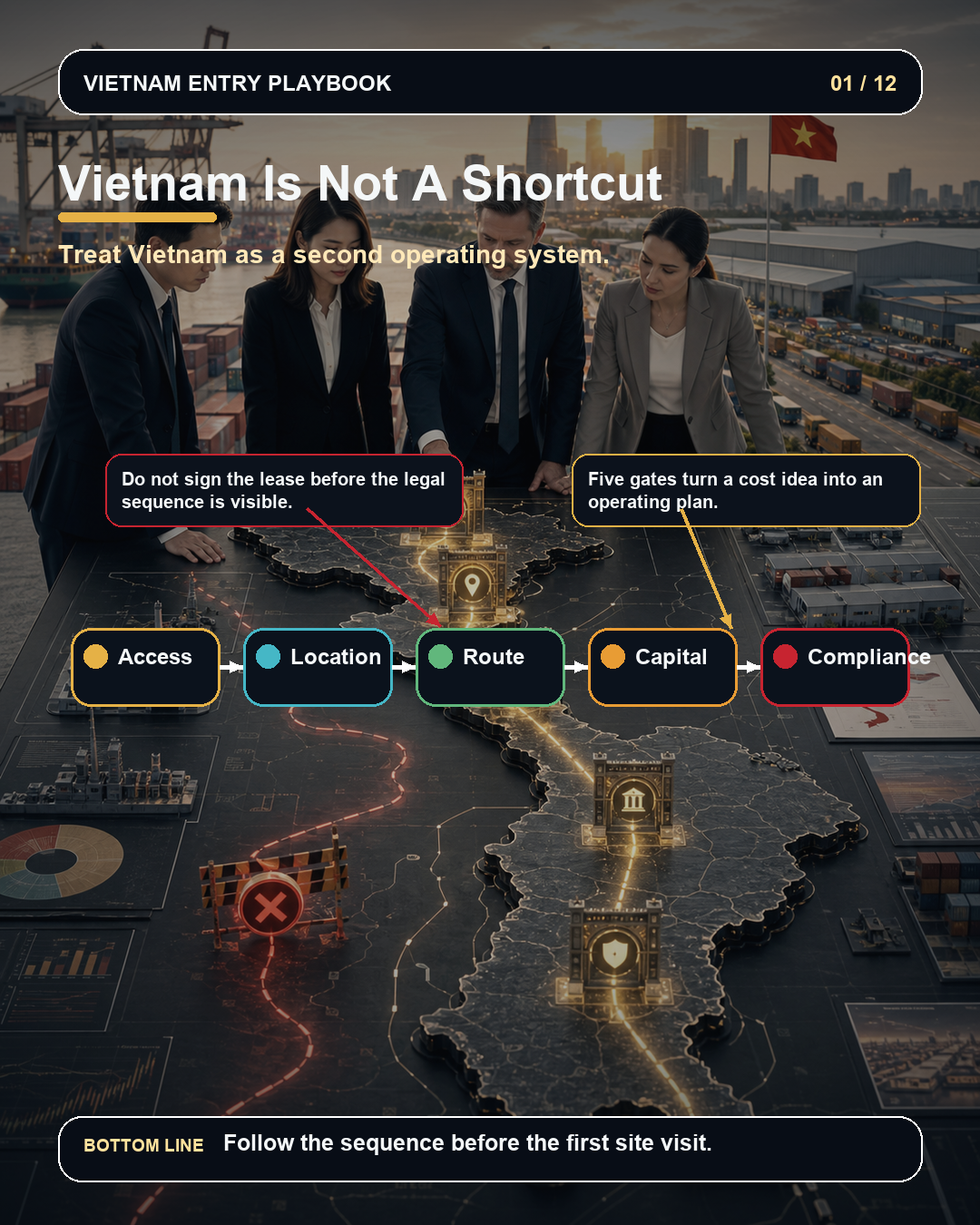
China plus one is not a slogan. For an SME owner, it is an operating design problem.
The boardroom version sounds clean: diversify supply chain, reduce concentration, access Vietnam, lower cost, get closer to ASEAN, protect margins.
The operator version is harder: who supplies, who checks quality, who owns the factory relationship, where goods move, which entity contracts, how money flows, what happens when the owner is not there, and whether Vietnam is actually the right second base.
Start with the job Vietnam must do
Do not begin with “We need Vietnam.”
Begin with the job:
- Reduce supplier concentration.
- Add backup manufacturing.
- Serve ASEAN customers.
- Build a local sales channel.
- Source a specific product.
- Move part of assembly.
- Set up warehousing or inspection.
- Create a lower-risk regional option.
Each job creates a different entry path.
A sourcing office is different from a factory. A contract-manufacturing network is different from a wholly owned plant. A local distributor is different from a Vietnam entity selling directly.
The SME mistake
Large companies can absorb slow learning. SME owners usually cannot.
The common SME mistake is trying to copy a corporate China plus one plan without the corporate team behind it. The owner visits factories, meets agents, sees a promising industrial zone, hears good cost numbers, and then starts building a project around fragments.
That creates dependency:
- Dependency on one introducer.
- Dependency on one supplier.
- Dependency on one bilingual staff member.
- Dependency on the owner’s memory.
- Dependency on informal promises.
The goal is not only a Vietnam option. The goal is a Vietnam option that does not trap the owner inside every daily issue.
Three entry models
Most SME China plus one plans fit one of three models.
1. Supplier network first
You keep your existing entity and build a Vietnam supplier base.
Best for testing products, quality, lead times, communication, and price before committing to setup.
Watch for quality control, exclusivity, payment terms, inspection, export documents, IP, and whether the supplier can really scale.
2. Local operating presence
You establish a Vietnam entity or representative structure to coordinate sourcing, inspection, warehousing, sales support, or local staff.
Best when repeated coordination is needed.
Watch market access, permitted activities, employment, office or warehouse fit, banking, tax, and whether the local team has authority without losing control.
3. Manufacturing or site commitment
You lease, build, acquire, or partner around production.
Best when the product, volume, customer demand, site logic, and capital plan are already clear.
Watch land or factory lease, fire approval, environmental approval, utilities, labor, customs, incentives, capital contribution, and project timeline.
What to compare with China
Vietnam should not be judged only on headline labor cost.
Compare:
- Total landed cost.
- Quality stability.
- Supplier depth.
- Tooling and engineering support.
- Lead time.
- Logistics and port access.
- Management time.
- Working capital.
- Tax and customs handling.
- FX exposure.
- Risk of losing control as the network grows.
Sometimes Vietnam wins. Sometimes China remains stronger. Sometimes the answer is not either-or, but a controlled second lane.
The owner-independent layer
For SME owners, the hidden question is: “Can this run without me chasing everything?”
Build the operating layer early:
- Supplier scorecard.
- Weekly exception report.
- Quality issue log.
- Cost and margin tracker.
- Shipping and document checklist.
- Partner meeting notes.
- Photo and evidence standards.
- Decision log.
- Escalation rules.
Then add AI carefully where it helps: summarizing supplier updates, comparing quotes, drafting SOPs, extracting shipment details, creating checklists, and maintaining a decision archive.
AI does not replace local judgment. It reduces owner dependency when the underlying process is clear.
The practical sequence
For an SME China plus one plan, use this order:
- Define the job Vietnam must do.
- Test suppliers or partners before structure if possible.
- Compare total landed cost, not only unit cost.
- Decide whether you need a local entity.
- Check market access, licenses, site, and capital route.
- Build operating controls before volume rises.
- Keep the owner dashboard simple and weekly.
If you want to pressure-test a China plus one path, send Les the product, supplier stage, target region, and current decision through WhatsApp, WeChat, or Zalo.